
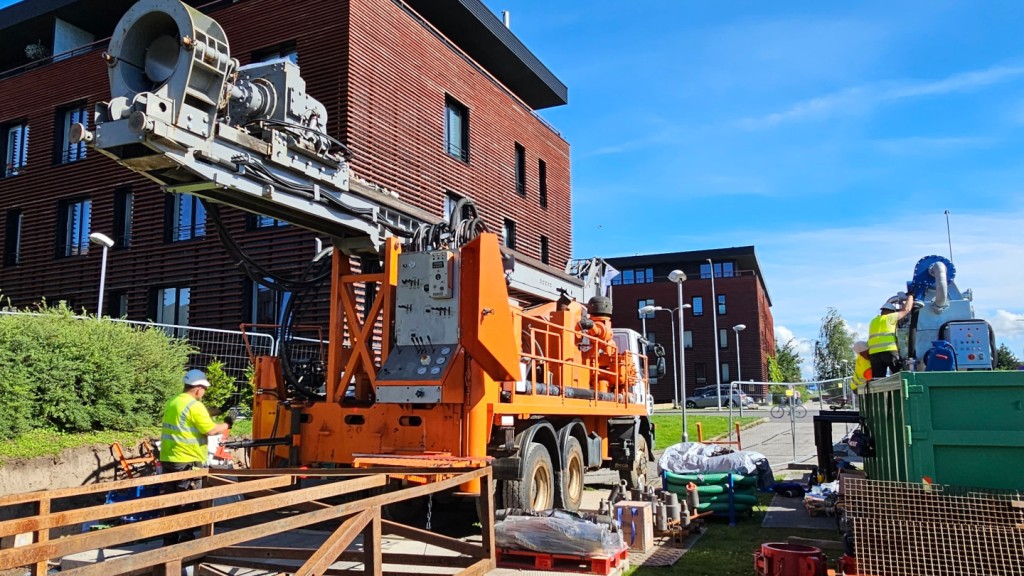
The final depth of the borehole is planned to be 500 metres. The location of the test station was chosen primarily with geological conditions in mind, but the availability of a district heating network of a suitable size in the area is also important. When the borehole is completed, the longest U-tube in Estonia will be installed in it, as well as a distributed temperature sensor, which is unique in Estonia. The system comprises a laser-equipped measuring device and a fibre-optic cable capable of measuring the temperature once per minute at least every metre. Such a system allows for the optimisation of the system’s parameters based on changes in consumption and, in the long term, to acquire knowledge about the potential for energy from the earth’s crust of Estonia. Importantly, the performance parameters of the system will be public, and in the future, this knowledge will help to better design and implement new geothermal energy systems. Within the same project, a test station will also be established in Roosna-Alliku in Järva County, and drilling will begin there in October this year.
The study on the potential of medium-deep geothermal heat, which focused on Northern Estonia and the rocks in its earth’s crust, will be followed by a study which will research the geothermal potential of ice-age sediments. Ice-age sediments are common all over Estonia and thus the planned study on the sediments’ energy potential will provide valuable information for the establishment of new carbon-neutral heating and cooling systems.
Additional information:
Aivar Auväärt
Email: [email protected]
Phone: +372 521 3831

