
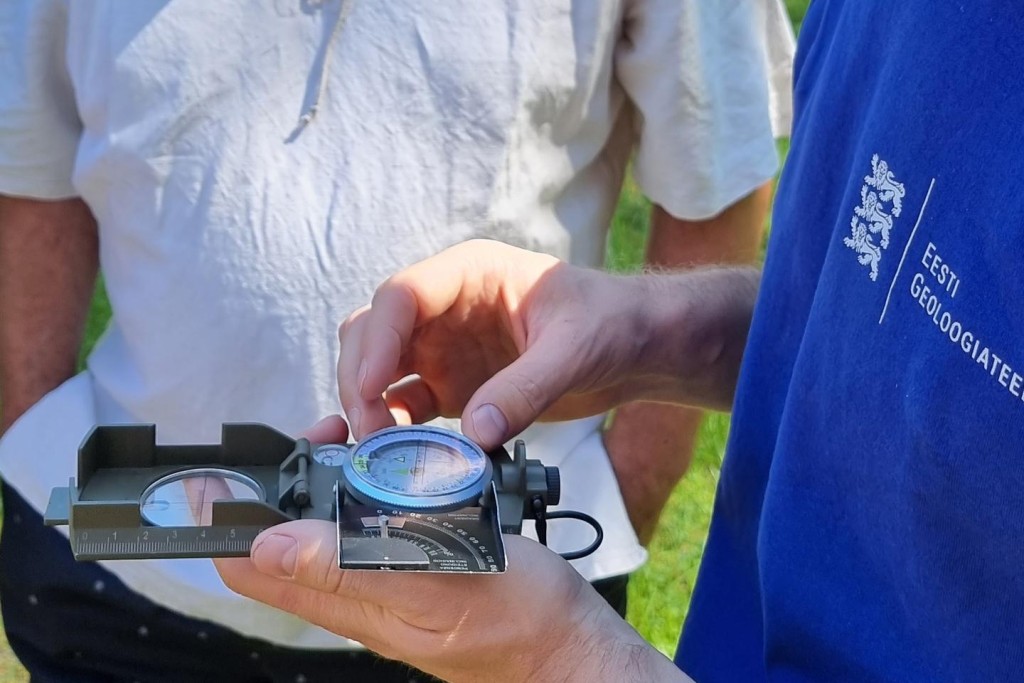
GSE intends to initiate several drilling campaigns intending to study sedimentary mineral deposits in Estonia. Prior to new drillings, however, sampling of black shale from existing cores was performed.
The current report presents data on the geochemical properties of the Türisalu Formation black shales (Tremadocian age) in north-west (NW) Estonia. The samples for geochemical analyses were collected from 11 cores which were drilled several decades ago. These studied drill cores are roughly aligned along two intersecting NE-SW and NW-SE transects.
The current report presents data on the geochemical properties of the Türisalu Formation black shales (Tremadocian age) in north-west (NW) Estonia. The samples for geochemical analyses were collected from 11 cores which were drilled several decades ago. These studied drill cores are roughly aligned along two intersecting NE-SW and NW-SE transects.
The accomplished analyses indicate that the relative intensity of mineralisation in the Tremadocian black shale of NW Estonia is the following: Mo>U>Ag>V>Pb>As. The average concentration of V increases westwards in the study area, while similar trends for U, Ni, and Zn are less pronounced. The vertical distribution of trace elements (V, Mo, U, Zn) in the studied drill cores shows that concentrations of those elements mostly increase towards the basal part of the black shale bed. The statistical analyses of geochemical data point to the tendency of V, U, Mo, Pb, Ag, Re, Sb to be associated with the organic matrix in black shales. The elements Zn and Cd form a distinctive association with each other, and these elements exist either in sulfide or organic-related forms. Sphalerite was identified by XRD in 28 samples out of 105. Ni, Co, and As are primarily associated with sulfide minerals (particularly pyrite) of the examined black shale.
The available historical geochemical data from the same drill cores were compared with the results of the current ICP-MS study. Comparison revealed biased values for several elements (V, Ni, Zn, Pb, Ag) in historical data. Concentrations are 1.3 to 2.7 times higher on average in the new measurements. U and Mo are in a better agreement between the old and new measurements.
For more information you can download the research report.

