
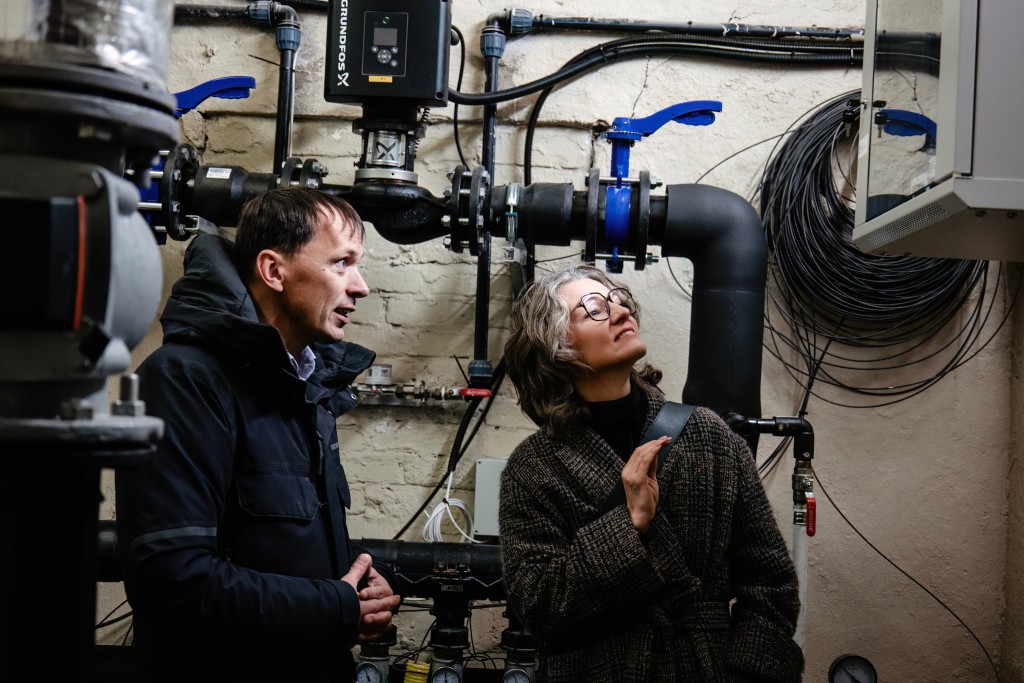
The Roosna-Alliku pilot plant was built as part of the GEOENEST project, providing an innovative alternative energy solution to current shale oil-based boiler. Five geothermal boreholes were drilled in Roosna-Alliku down to crystalline basement with a depth of nearly 500 metres, to extract the geothermal heat to supply the local district heating network. The completed pilot plant has a heat output of approximately 400 kW, providing heat for buildings with a total area of up to 6,581 m².
According to Minister of Climate Yoko Alender, the establishment of the pilot plant marks a significant step towards improving the well-being of both the Estonian environment and its people. ‘We need new sources of clean energy to phase out fossil fuels and ensure sustainable and affordable heating for everyone. The Roosna-Alliku pilot plant offers valuable insights and experience that can help scale up similar technologies in other areas where solar panels or wind turbines are not economically viable.’
According to Sirli Sipp Kulli, Director of the Geological Survey of Estonia, the completion of the Roosna-Alliku geothermal pilot plant marks the next phase of the GEOENEST project, a joint research project conducted by the Geological Survey of Estonia and the Ministry of Climate to explore the uses of geothermal energy. ‘One of the objectives of the Geological Survey of Estonia is to investigate the usability of geothermal energy applications in Estonia, as well as the use potential of mine water and seawater thermal energy applications. By establishing geothermal pilot plants, we can gather more accurate data on their potential in different parts of Estonia. In Finland and Sweden, geothermal energy has been a key component of thermal engineering for decades and I believe its use will also accelerate in Estonia in the coming years,’ said Sirli Sipp Kulli.
According to Aivar Auväärt, who led the project on behalf of the Geological Survey of Estonia, the location of the pilot plant was chosen primarily based on geological conditions, with the availability of an appropriately sized district heating network in the area also being a key factor. ‘A total of five U-shaped pipes, through which coolant circulates to extract heat from the rocks, along with a distributed temperature sensor, were installed in the 500-metre-deep boreholes. The system includes a measuring device equipped with a laser and a fibre optic cable that can measure temperature once in a minute at least after each metre,’ explained Aivar Auväärt.
Such a system allows for the optimisation of the system’s parameters based on changes in consumption and, in the long term, to acquire knowledge about the potential for energy from the earth’s crust of Estonia. ‘It is important that the performance parameters of the system are made public, as this knowledge can be used in the future to improve the design and operation of geothermal energy systems,’ added Auväärt. According to various estimates, geothermal heat pumps could lower the heating costs by 30–60% and cooling costs by 20–50% compared to conventional heating and cooling systems.
In spring, the Geological Survey of Estonia opened a geothermal pilot plant in Tiskre, Tallinn, and another pilot plant is currently under construction at the Arbavere Research Centre of the Geological Survey of Estonia. Next, the Geological Survey of Estonia plans to investigate the thermal potential of groundwater circulating in thick (100 m or more) soft sediments at several locations across Estonia. Although the heat generation potential of these boreholes is expected to be lower than that of deeper boreholes, the soft sediments and shallower depths result in significantly lower drilling costs. This could substantially reduce the most expensive cost component of geothermal stations – drilling –, making such solutions more attractive to smaller consumers.
The use of geothermal solutions is becoming more widespread in Estonia, with 563 new geothermal boreholes drilled in 2023, the majority of which are 100 metres deep. Horizontal ground loops are more commonly used, but in densely populated areas, there may not be enough land to harness the required thermal energy. As a result, obtaining thermal energy from boreholes is an alternative for sourcing fossil fuel-free heat.
In the construction of the Roosna-Alliku geothermal pilot plant, the Geological Survey of Estonia co-operated with Inseneribüroo Steiger OÜ, TJ Hooldus OÜ, Balrock OÜ and HeatConsult OÜ.

