
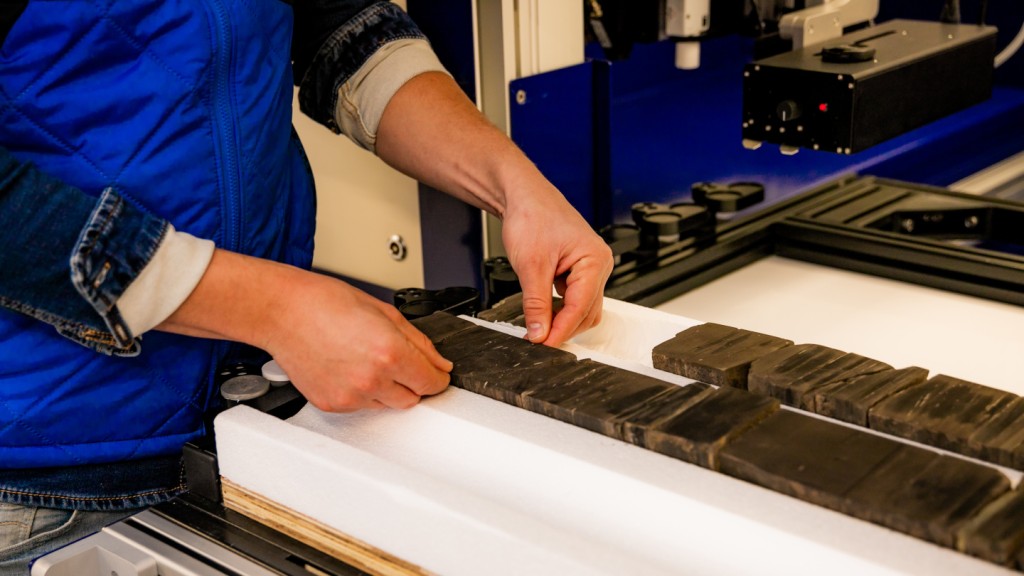
The modern Geotek equipment includes an XRF (X-ray fluorescence) sensor, an infrared spectrophotometer, a camera and a magnetic susceptibility sensor. This system allows us to simultaneously obtain a high-quality image of the drill core, the chemical composition and magnetic susceptibility of rocks as well as partially identify the minerals it contains.
According to Tiit Kaasik, Head of the Department of Mineral Resources at the Geological Survey, the repositories of the Geological Survey hold nearly 21,000 crates of drill cores, of which more than 3500 contain crystalline rocks. ‘Crystalline rocks found in Estonia are similar to rocks in Finland and Sweden,’ claimed Kaasik, ‘but in our region, they are usually covered with sedimentary rocks. These cores were studied very thoroughly in the Soviet era, based on the methodology of the time, but the focus was on the metals that were in demand in that period. The presence of many raw materials now considered critical in the crystalline rocks of Estonia has not yet been systematically analysed,’ added Kaasik, explaining the need for more comprehensive research.
With traditional methods, searching for previously unknown critical raw materials from existing drill cores is time-consuming and labour-intensive. ‘Comprehensive laboratory analysis of rock samples is technically and financially difficult and such a method destroys a great deal of valuable material. Automatic scanning allows us to obtain a continuous high-resolution set of data, which can be used to look for signs of the distribution of elements of interest and, based on that, direct future studies significantly more accurately and efficiently,’ said Kaasik.
‘Broadly speaking, critical raw materials are resources which have an important role in the economy and whose security of supply is for some reason at higher risk. Nowadays, they are mostly resources used in the green and digital economy. The market value of critical raw materials will increase over time – presumably 5-10 times over the next few decades. Given the geological structure of our earth’s crust, there is still potential to find undiscovered critical raw materials in Estonia, especially in the crystalline basement,’ concluded Kaasik.
The workstation’s fields of use are not only limited to the search of critical raw materials in the crystalline basement. Among other things, the equipment will be used in phosphorite and black shale studies. In addition, it allows us to search for elements of interest in samples taken from extractive waste.
The method is also used in marine geology, which usually scans cross-sections collected from soft sediments, not rocks. By scanning cross-sections of sediment, it is possible to quickly determine changes in chemical composition and thereby assess environmental changes in the development of the sedimentary basin.
The workstation also opens up opportunities for the emergence of new areas of academic research that study various geological materials.
The workstation of the Geological Survey is one of a kind in the Baltic states and will undoubtedly elevate our analytical capability to a new level.

