
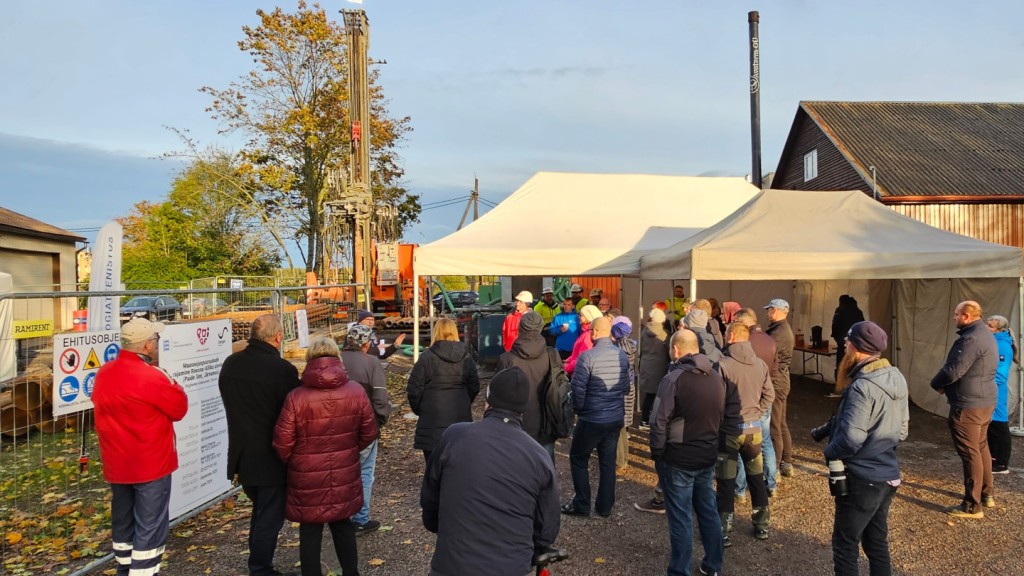
‘The proposed test station is expected to reduce heat production cost by up to 50% according to our estimations, as geothermal energy is one of the most efficient and also environmentally friendly forms of heat energy when compared to other alternatives. It is a renewable energy source and using geothermal energy heat pumps has a small carbon footprint,’ said Aivar Auväärt, Head of the Department of Geothermal Energy of the Geological Survey. The location of the Roosna-Alliku test station was selected primarily considering the geological conditions, but having a district heating network of suitable size was also important. ‘When the borehole is completed, extra long U-tubes with distributed temperature sensors are installed in the boreholes. The system includes a measuring device equipped with a laser and a fibre optic cable that can measure temperature once in a minute at least after each metre. Such a system allows optimising the system parameters according to the changes in consumption and over time it will also provide information on the energy potential of Estonia’s earth’s crust,’ Aivar Auväärt added. The operational parameters of the system to be established will be public and based on this knowledge it will be possible to design and implement new geothermal energy systems more efficiently. According to the plan, the Roosna-Alliku test station is scheduled to be completed by next summer.
Construction of the Roosna-Alliku test station is a part of the GEOENEST project of the Geological Survey which is financed by the Ministry of Climate. The project’s goal is to help reach Estonia’s energy and climate policy objectives by analysing and testing the options for implementing geothermal energy. The primary objective of the project is to establish test stations based on geothermal boreholes in Roosna-Alliku and Tiskre, and to assess the implementation potential of Estonian geothermal energy based on these stations.
For high-level execution of surveys related to geothermal energy, the Geological Survey is currently also carrying out a 3-year twinning project EGT-TWINN which is financed by the European Union. The primary aim of this project is to significantly expand cooperation and knowledge exchange with the geological surveys of the leading geothermal energy users in Northern European countries such as Finland, Denmark and the United Kingdom.
Additional information:
Aivar Auväärt
Phone: 5213831
Head of the Department of Geothermal Energy

