
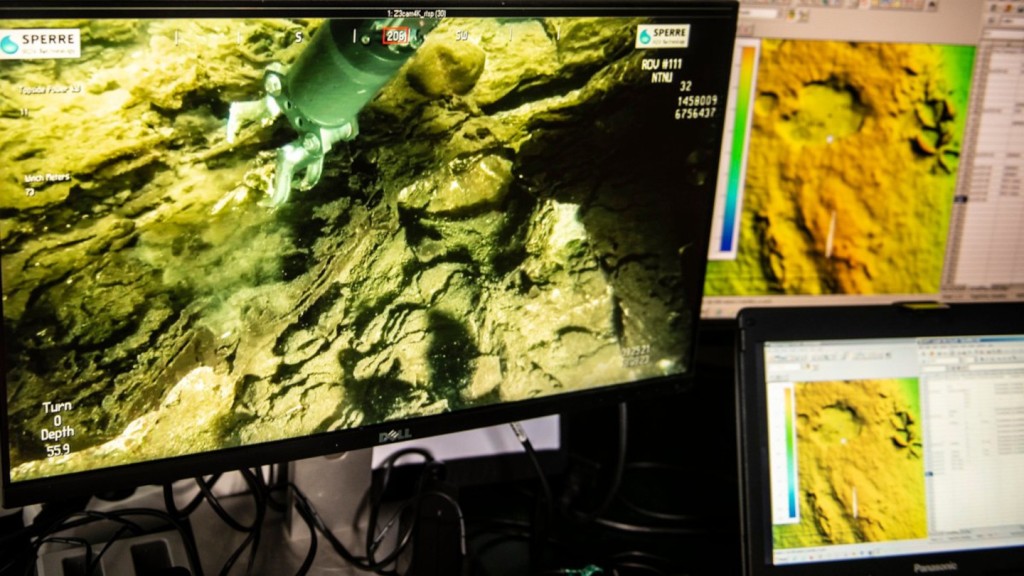
The research was carried out using a modern ROV (remotely operated vehicle) specially delivered for this purpose from the Norwegian University of Science and Technology of Trondheim, which allows detailed filming of the seabed and collection of samples with several different samplers. This ROV system is analogous to the robot that was recently used to investigate the wreck of Estonia and take samples from the seabed. According to Sten Suuroja, Head of the Department of Marine Geology and Geophysics of the Geological Survey, the seabed of the Gulf of Finland is an exciting area for exploration in the Baltic Sea. ‘Since the Geological Survey of Estonia is currently conducting an overview of the distribution and formation of ferromanganese nodules in the Gulf of Finland, this was one of the main goals of our expedition,’ he explained. Ferromanganese nodules are chemogenic deposits formed as a result of natural processes, and their formation is not associated with anthropogenic pollution. Nodules are found in relatively large areas in Estonian waters, but their concentration is very variable. ‘During the studies, we received a couple of tens of kilograms of various rocks and sediments from the seabed with a ROV, and studying them in cooperation with Taltech scientists will definitely give us new information in this regard,’ Suuroja added.
The main coordinator of the project, Aivo Lepland from the Geological Survey of Norway, added that in addition to the nodules, the researchers saw large holes in the seabed in the middle of the Gulf of Finland. ‘They range in diameter from a few tens of meters to a few hundred meters, and they are up to three meters deep. The holes have formed through groundwater rising from the bottom of the sea, which creates changes in the seabed,’ stated Lepland. Hole-like landforms are important to study, according to Lepland, because a unique colony of microbes lives around them. ‘We are studying the interaction of all this: the nodules, the processes on the seabed where the water comes out, as well as marine biology and the activities of the microbes influenced by these processes,’ he explained. The expedition was a continuation of the expedition carried out last year, in the framework of which primary data on the distribution of ferromanganese nodules in the Estonian waters of the Gulf of Finland was collected. Last year, the research vessel Electra from Stockholm University was used for research.
The research was mainly funded by the international Norwegian-Polish research project Arctic SGD: Submarine Groundwater Discharge in a Changing Arctic: Scale and Biochemical Impact.

